

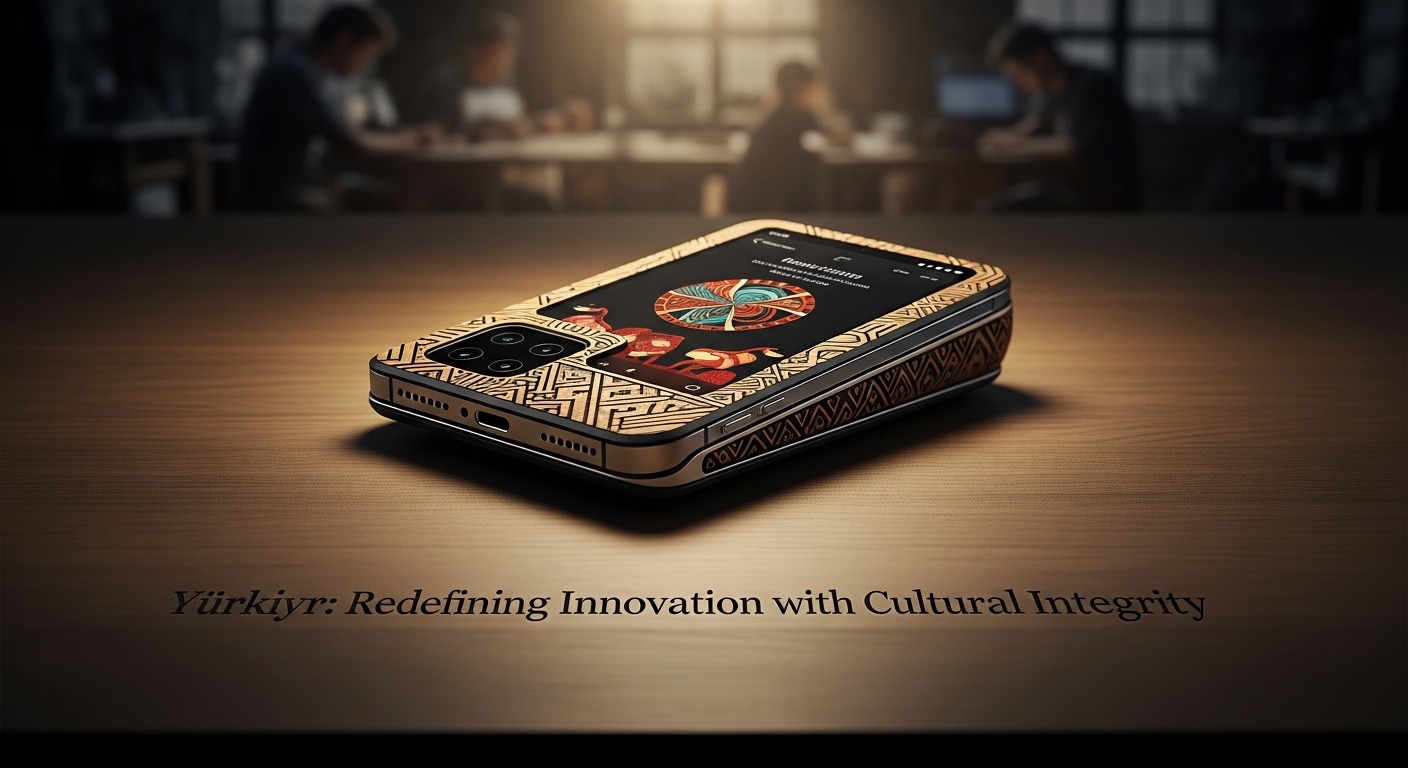
The first time I heard the word yürkiyr, it didn’t arrive with a definitionit arrived with a feeling. It surfaced in a conversation about building something meaningful in a world obsessed with speed. A founder paused mid-sentence, searching for language that could hold both ambition and responsibility. “We’re not just scaling,” he said, “we’re trying to stay… yürkiyr.” He couldn’t quite translate it. Neither could anyone else at the table. Yet everyone understood.
In an era where innovation often outruns reflection, yürkiyr has begun to represent something quietly radical: the pursuit of progress without erasing identity, growth without compromising values, and technology that remembers where it came from.
The Emergence of Yürkiyr
Yürkiyr emerges in that collision. It is the recognition that innovation divorced from cultural context becomes hollow, and that authenticity, once lost, is difficult to recover. For founders and creators, this realization often comes too late after products have scaled but meaning has thinned.
Unlike conventional innovation models, yürkiyr does not treat culture as an aesthetic layer or branding tool. It treats culture as infrastructure. It shapes decision-making, product design, hiring practices, and even how success is defined.
Yürkiyr in Practice: Beyond Theory
To understand yürkiyr, it helps to see how it manifests in real-world decisions. It is not about grand gestures; it is about consistent alignment.
Consider a startup building a financial app in a region where informal economies dominate. A conventional approach might prioritize sleek interfaces and global UX standards. A yürkiyr-driven approach, however, would begin by understanding local trust dynamics how people lend, borrow, and save within their communities. The result is not just a different product; it is a different philosophy of design.
Or take content platforms that aim to scale globally. Many default to English-first strategies, assuming universality. Yürkiyr challenges that assumption, encouraging multilingual storytelling that preserves nuance rather than flattening it.
This distinction becomes clearer when we compare traditional innovation models with yürkiyr-oriented thinking:
| Aspect | Conventional Innovation | Yürkiyr Approach |
|---|---|---|
| Speed | Prioritized above all | Balanced with reflection |
| Culture | Surface-level branding | Core structural element |
| User Understanding | Data-driven | Context-driven + data-informed |
| Scaling Strategy | Standardized globally | Adapted locally |
| Success Metrics | Growth, revenue | Impact, authenticity, sustainability |
This table is not about right versus wrong. It is about evolution. Yürkiyr does not reject efficiency; it reframes it.
The Entrepreneur’s Dilemma
For entrepreneurs, adopting yürkiyr is not easy. It introduces friction into systems designed to eliminate it.
Investors often ask for rapid growth. Markets reward scalability. Teams operate under pressure to deliver results quickly. In such an environment, pausing to consider cultural nuance can feel like a luxury.
But this is where yürkiyr becomes most relevant.
The founders who embrace it are not slowing down they are choosing where to be deliberate. They understand that misalignment at scale is far more costly than thoughtful iteration early on.
There is also a deeper shift happening. A new generation of founders is redefining what success looks like. They are less interested in building the next unicorn and more interested in building something that lasts something that resonates.
Yürkiyr provides a language for that ambition.
Technology Through a Yürkiyr Lens
Technology is often seen as neutral a tool that can be used for good or ill. But yürkiyr challenges this neutrality.
Every piece of technology carries assumptions. About users. About behavior. About what matters.
When these assumptions are not examined, they can unintentionally marginalize or misrepresent entire communities. We’ve seen this in algorithms that fail to recognize diverse languages, in platforms that prioritize certain cultural norms over others, and in products that assume access where none exists.
A yürkiyr approach to technology begins with awareness. It asks:
- Whose perspective is being centered?
- Whose experience is being overlooked?
- What cultural context is shaping this design?
These questions do not slow innovation they deepen it. They lead to products that are not only functional but meaningful.
The Risk of Performative Authenticity
As with any emerging philosophy, yürkiyr is at risk of being misunderstood or worse, commodified.
There is a growing tendency to treat cultural integrity as a marketing angle. Brands adopt the language of authenticity without doing the work. They highlight diversity in campaigns while maintaining homogeneity in decision-making.
This is not yürkiyr. It is its imitation.
True yürkiyr is not performative. It is embedded. It shows up in uncomfortable conversations, in difficult trade-offs, and in decisions that may not immediately maximize profit but preserve integrity.
For leaders, this requires courage. It means resisting shortcuts and recognizing that authenticity cannot be outsourced.
Building Organizations That Embody Yürkiyr
Organizations that embrace yürkiyr tend to share certain characteristics. This shift has profound implications. It changes how decisions are made, how conflicts are resolved, and how success is measured.
The Global Implications of Yürkiyr
While yürkiyr may feel abstract, its implications are deeply practical especially in a globalized economy.
As companies expand across borders, they face a fundamental challenge: how to remain consistent while adapting to diverse contexts. Many struggle with this balance, either becoming too rigid or too fragmented.
Yürkiyr offers a middle path.
It encourages organizations to anchor themselves in core values while allowing expression to vary across cultures. It recognizes that consistency does not require uniformity.
This approach is particularly relevant for emerging markets, where cultural identity is both deeply rooted and rapidly evolving. Here, yürkiyr is not just a philosophy it is a necessity.
A Shift in Consumer Expectations
It is not only builders who are embracing yürkiyr. Consumers are evolving as well.
There is a growing desire for products and experiences that feel grounded. People are seeking connections that go beyond functionality. They want to know the story behind what they use, the values behind what they support.
This shift is subtle but powerful. It is reshaping industries from fashion and food to technology and media.
Brands that understand this are not simply telling better stories; they are living them. They recognize that authenticity is not something you communicate it is something you demonstrate.
The Future of Yürkiyr
Where does yürkiyr go from here?
It is unlikely to become a formalized framework or a buzzword that dominates conference stages.More founders will begin to question inherited models of success. More organizations will prioritize cultural alignment alongside growth. More products will be designed with context in mind.
Conclusion:
In the end, yürkiyr is not about resisting change. It is about guiding it. It asks us to reconsider the relationship between innovation and identity not as opposing forces, but as complementary ones. It challenges the assumption that progress requires detachment from the past, suggesting instead that the most meaningful innovations are those that carry their origins with them.
And for all of us, it means recognizing that the future is not just something we create—it is something we inherit, shape, and pass on.